Civitas Learning: How AI Is Transforming Student Success in Higher Education
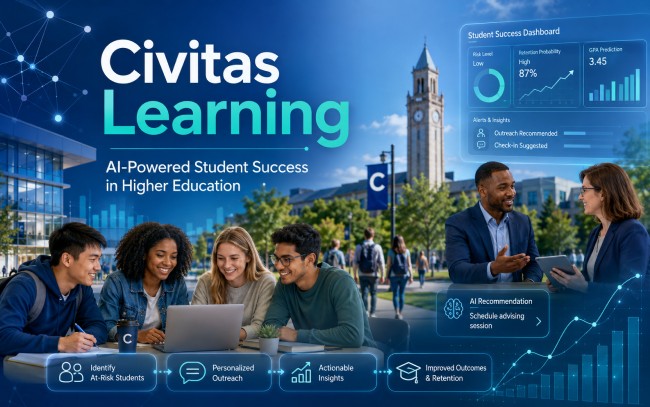
Civitas Learning is an education technology company focused on helping colleges and universities improve student outcomes. Founded in 2011, the company uses artificial intelligence, predictive analytics, data science, and academic planning tools to help institutions understand student needs and take action at the right time.
Based in Austin, Texas, the company works mainly with higher education institutions. Its technology connects data from different campus systems and turns it into useful insights for advisers, faculty members, administrators, and institutional leaders. The goal is simple: help more students remain enrolled, complete their studies, and reach their academic goals.
Today, the company is backed by Francisco Partners and operates as a private technology business. Its main product is the Student Impact Platform, which combines institutional data, AI, advising tools, planning systems, and analytics within one environment.
What Is Civitas Learning?
Civitas Learning develops software designed for colleges and universities. Higher education institutions often store student data across many separate systems. Academic records may sit in one system, attendance details in another, course activity somewhere else, and advising notes in another platform. This separation can make it difficult for staff to understand the full situation of each student.
The company’s technology brings these different data sources together. It then uses analytics and institution-specific AI to find patterns that may affect student success. Staff can use these insights to identify barriers, communicate with students, plan support, and measure the success of their actions.
Civitas Learning Was Founded in 2011
The company began in 2011 with a strong focus on improving the way higher education institutions use data. Charles Thornburgh, Mark Milliron, Laura Malcolm, and Adam Dell have been connected with its founding. Charles Thornburgh became one of the most visible early leaders and served as the original chief executive officer.
Mark Milliron brought deep experience in education and student achievement. Laura Malcolm played an important role in strategy and outcomes, while Adam Dell contributed technology and business experience. During its early years, the company grew from working with a small group of colleges into serving a much larger higher education market.
Civitas Learning Quick Info
| Detail | Information |
|---|---|
| Company Name | Civitas Learning |
| Founded | 2011 |
| Headquarters | Austin, Texas, USA |
| Industry | Education Technology (EdTech) |
| Company Type | Privately Held |
| CEO | Will Ballard |
| Website | civitaslearning.com |
| Main Product | Student Impact Platform |
| Core Services | AI, Predictive Analytics, Student Success Analytics |
| Main Market | Colleges and Universities |
| Major Investor | Francisco Partners |
| Funding | Approx. $89 million in disclosed venture funding |
| Key Goal | Improve student retention, persistence and completion |
| Phone | 512-692-7175 |
| Founded By | Charles Thornburgh, Mark Milliron, Laura Malcolm & Adam Dell |
Civitas Learning Headquarters and Company Size
The company is headquartered in Austin, Texas. Its LinkedIn company page places its workforce within the 51–200 employee range. The business has used different Austin addresses during its history. The well-known address at 100 Congress Avenue was used in earlier years and can still be found in older business records.
More recent company material has used addresses including 6705 W Highway 290, Austin, Texas, while LinkedIn has also displayed an Austin location on Mesa Drive. This means 100 Congress Avenue should be treated as a historic address rather than the safest current mailing address. The company phone number is 512-692-7175.
International Presence
Its operations have also extended beyond Texas. Company materials have connected the business with locations in California, the United Kingdom, and India. Its presence in Pune, India, supports technology and operational activities through Edustream. This international reach helps the company support a technology platform used across different education environments.
Civitas Learning Student Impact Platform
The Student Impact Platform is the company’s main technology solution. It acts as a central system where colleges can combine data, analytics, communication, academic planning, and student support activities. The platform is designed for institutional leaders, advisers, faculty members, data teams, and students.
Student Success Analytics
Student Success Analytics helps advisers and support teams identify students who may need attention. Instead of waiting until a student fails a course or leaves college, staff can use predictive indicators to act earlier. Advisers may review student records, notes, academic progress, alerts, communication history, and possible risk factors from one connected environment. This supports a more proactive approach to student care.
Administrative Analytics
Administrative Analytics focuses on larger institutional outcomes. College leaders can study retention, persistence, completion, academic performance, and the effect of different student support programmes. This gives decision-makers a clearer way to understand which efforts create meaningful results and which programmes may need improvement.
Degree Planning and Scheduling
Academic planning is another important area. Students can use planning tools to organise degree requirements and prepare future course schedules. Scheduling technology can reduce timetable conflicts and make course selection easier. Institutions can also study future course demand. This can help them decide how many classes, instructors, or sections may be required.
How Civitas Learning Uses Artificial Intelligence
Artificial intelligence has become a major part of the company’s current direction. Instead of depending only on general education data, its approach focuses strongly on institution-specific AI. This means models can use the unique history, programmes, students, and outcomes of an individual college or university. That approach can create insights that are more closely connected to the institution using the system.
Predictive Models
Predictive models can analyse academic history, student engagement, course activity, programme progress, and other factors. The company states that its technology can achieve 89% accuracy when predicting student outcomes. This figure comes from the company’s own performance material, so it should be treated as a company measurement rather than a guaranteed result for every institution.
AI Agents and Assistants
The platform has expanded into generative and agentic AI. AI assistants can help staff prepare for student meetings, summarise important details, review institutional data, create useful insights, and support communication. The company also allows institutions to create AI agents using natural-language instructions. This reduces the need for advanced programming skills. Human involvement remains important. The company’s current direction supports AI as a tool for helping staff make stronger decisions rather than replacing human judgement.
Student Retention and Completion Results
Civitas Learning states that its institutional partners commonly achieve a 3% to 11% improvement in retention and persistence. It also states that partners may achieve a 2% to 13% improvement in completion rates. These figures describe outcomes shared by the company and should not be treated as guaranteed results for every college. Its 2026 student success research examined 220 student-success initiatives across five years of data. One major finding was that not every student support programme creates measurable improvement.
The research also showed the importance of human contact. Advising appointments and targeted communication were among the stronger forms of intervention. An important AI finding showed that technology without proper adviser involvement can produce weaker outcomes. This supports the company’s focus on combining technology with human expertise.
Civitas Learning Funding and Investors
The business attracted major investment during its growth. Early investment included approximately $4.2 million, followed by an $8.75 million funding round in 2013. In 2015, another $16 million investment supported expansion. Later that year, Warburg Pincus led an investment commitment of up to $60 million. By that stage, total disclosed venture investment was close to $89 million, although financial databases may use slightly different totals.
Francisco Partners Investment
A major change came in 2019, when Francisco Partners made a significant growth investment in the company. Financial terms were not disclosed. Francisco Partners continues to identify the business within its investment portfolio. The company remains privately held, meaning detailed financial figures such as annual revenue, profit, current valuation, and ownership percentages are not openly published.
Acquisitions That Expanded the Business
Growth has also come through acquisitions. The company acquired BlikBook in 2015, strengthening student engagement technology and its connection with European higher education. In 2016, it acquired College Scheduler, adding powerful course scheduling and registration tools.
It later added AdviseStream, strengthening academic advising and student case-management capabilities. The acquisition of ClearScholar in 2018 expanded mobile student engagement technology. These deals helped transform the company from a predictive analytics business into a wider student success technology provider.
Data Security and Privacy
Student data requires strong protection. The company maintains security and compliance practices connected with standards and frameworks such as FERPA, GDPR, SOC 2 Type II, TX-RAMP Level 2, VPAT, and HECVAT. Its privacy policy states that student data is not sold to third parties. Encryption, controlled access, data protection processes, and privacy safeguards are important parts of its technology environment.
Why Civitas Learning Matters in Higher Education
Modern universities produce huge amounts of data, but data alone does not improve student success. The real value comes from helping staff understand what is happening, identify problems early, take useful action, and measure whether those actions work. Civitas Learning brings these tasks together through analytics, AI, academic planning, advising, communication, and institutional measurement.
Its development since 2011 shows how education technology has moved beyond simple dashboards. The company now focuses on what it calls Institutional Impact Management, where data and AI support coordinated action across the campus.
With its Student Impact Platform, institution-specific AI, predictive analytics, academic planning technology, and backing from Francisco Partners, Civitas Learning remains an established name in higher education technology. Its long-term purpose continues to centre on one major goal: helping institutions give students better opportunities to stay enrolled, complete their education, and succeed.