Syrenis Limited: Powering Global Consent, Privacy and Digital Trust
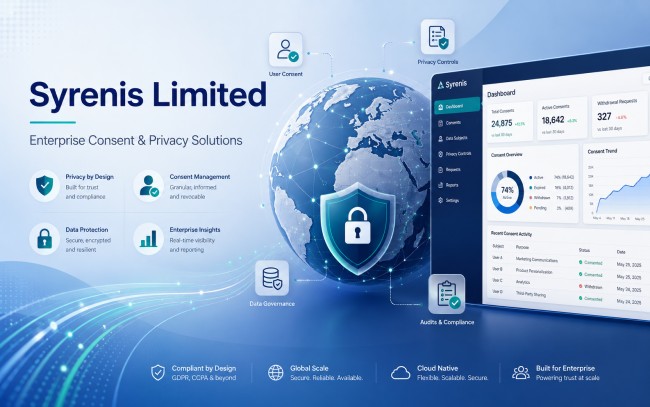
Syrenis Limited is a British privacy-technology company that helps large organisations manage consent, customer preferences and privacy notices across complex digital systems. Its software creates one controlled record of how a person has agreed to let a business use data. That record can guide websites, apps, customer portals, marketing tools and internal platforms. Stronger privacy control can protect trust while supporting better customer experiences and business growth.
What Is Syrenis Limited?
Syrenis Limited is an active private company incorporated in England and Wales on 21 March 2000. Its company number is 03952704, and its registered office is at V2 Sci-Tech Daresbury, Keckwick Lane, Warrington, Cheshire. The business has spent more than 25 years developing consent and preference software. Its main focus is enterprise privacy technology for organisations managing large volumes of personal data across many regions.
LinkedIn classifies the business within software development and places it in the 51–200 employee size band. The company describes itself as UK-headquartered, with United States operations supporting clients across North America. Its public company page also highlights work across the United States, Europe, the Middle East and Australia.
The History and Development of Syrenis Limited
The company began in 2000 and later became known through Cassie, its consent and preference management platform. Cassie helped enterprises collect permissions, connect identities and control data across business systems. By 2025, Syrenis stated that the platform managed more than 1.2 billion data records for global enterprises in fields such as finance, pharmaceuticals and automotive services.
From Cassie to the Syrenis Brand
On 21 April 2026, the company launched a major brand refresh. It retired its older product names and brought its platform under one Syrenis identity. This reflected a move from a compliance tool to a wider enterprise privacy platform focused on global scale, several legal regions, many brands, complex identities and real-time data governance.
Why the Cassie Name Still Matters
Older guides, product pages and customer material may still use the Cassie name. It refers to the same core consent and preference technology that now sits under the unified Syrenis brand. This history matters because businesses may know the software as Cassie even though the company now promotes the platform chiefly as Syrenis.
How the Syrenis Limited Platform Works
The platform collects privacy choices, matches them to the correct person or identity, and sends those choices to connected systems. It creates a single source of truth. When a customer changes a preference, the new decision can reach approved channels instead of remaining in one database. This reduces conflicts and helps teams honour the latest choice.
Centralised Consent Management
Consent may cover marketing messages, cookies, health data, financial data, research activity or other uses of personal details. Syrenis Limited helps enterprises record when consent was given, what purpose it covered and how it later changed. A clear record also supports internal checks and regulatory audits.
Cross-Domain and Follow-Me Consent
Cross-domain consent lets an organisation collect a privacy choice once and apply it across connected websites. Follow-Me Consent carries an identified customer’s choice across devices, sessions and touchpoints. These functions reduce repeated banners and consent fatigue while supporting a consistent experience through first-party data and identity-based methods.
Preference Management and Progressive Profiling
Preference management covers how customers want to communicate with a business, including channel, topic and message frequency. Progressive profiling gathers small amounts of data over time instead of using one long form, keeping the process simple.
Privacy Notices and Rights Requests
The wider platform includes tools for privacy notices, policy control and personal data rights. These functions can help teams manage access, deletion, correction and other requests in a governed process. Central control is valuable for companies operating through several brands, languages and legal regions.
Syrenis Limited and Global Privacy Compliance
Syrenis supports organisations working under major privacy frameworks, including GDPR, CCPA, CPRA, HIPAA, LGPD, PIPEDA and several state-level American laws. The software helps teams record choices, apply regional rules and keep evidence across connected systems. It does not replace legal advice or automatically make a business compliant. Each organisation must define lawful purposes, policies and responsibilities.
CCPA and CPRA Support
For businesses serving California residents, consent and preference controls may involve opt-outs, sensitive personal data, targeted advertising, data sharing and privacy rights. Syrenis promotes central records and governed data movement so a customer’s latest choice can reach marketing, analytics and operational systems. Its 2026 guidance also stresses verification, showing that businesses should confirm downstream exports and audience tools are following the correct preference.
Industries Served by Syrenis Limited
The platform is built for data-heavy sectors where privacy failures can cause serious harm. Its main industry areas include automotive, energy, financial services, healthcare, pharmaceuticals, legal technology, life sciences, media, publishing, retail and ecommerce. These sectors often handle sensitive data across many platforms.
Healthcare, Life Sciences and Insurance
Healthcare and life-sciences organisations may need to manage patient choices, research permissions, direct-to-consumer services and regional health rules. In July 2026, Syrenis described a life-sciences deployment using geo-aware consent, cross-domain control and identity services in one governed environment.
Insurance is another strong use case. Insurers receive medical and financial details and must honour policyholder choices across portals, underwriting teams, marketing channels and service systems. Syrenis has recently used an Australian life-insurance consent failure to show why operational control matters. Its message is that trust depends not only on data security but also on giving customers clear control and respecting that decision everywhere.
Automotive and Connected Data
Connected vehicles can produce location, driving and sensor data. Syrenis has described a global automotive project in which its enterprise platform centralised consent decisions at scale. The case shows how privacy choices can be linked to users, vehicles and separate data purposes within one controlled model.
Leadership and Ownership
Adam Binks joined the board in October 2024 and became chief executive in February 2025. He leads global expansion and the company’s move towards a broader enterprise privacy position. Martin Audcent serves as chief financial officer and supports financial control, governance and international growth. Other senior leaders oversee commercial strategy, American enterprise sales, product development and global delivery.
Companies House records active directors including Adam Binks, Martin Audcent and William Currie. It also identifies William Currie Investments Ltd and Maia+ Limited as persons with significant control, with each holding more than 25% but no more than 50% of shares and voting rights.
Security and Enterprise Reliability
Privacy software must protect highly sensitive records. The Cassie platform completed a SOC 2 Type II examination, which tests controls connected with customer data and sensitive information. It also achieved Cyber Essentials Plus for a third consecutive year. That certification includes independent technical checks covering areas such as access control, secure setup, malware protection, firewalls and patch management.
Syrenis also promotes an enterprise model built for high transaction volumes, resilience, complex identity structures and large integration needs. Its platform connects with customer relationship systems, marketing technology, data platforms, websites, apps and older internal tools. Real-time updates help prevent a privacy choice from being respected in one channel but ignored in another.
Business Strategy and Global Expansion
The company is expanding its presence in the United States while keeping its legal and operational roots in Warrington. Its leadership presents privacy as more than a legal cost. Better consent data can support relevant communication, stronger personalisation, fewer unwanted messages and improved trust. Syrenis calls this approach a way to turn compliance into a business enabler.
Its growth strategy focuses on global enterprises facing many laws, brands, customer identities and data systems. The 2026 rebrand, United States expansion and focus on regulated sectors all support this direction. The company also connects consent governance with responsible artificial intelligence, since AI systems need clear rules about which data may be used and for what purpose.
Workplace and Company Culture
Syrenis describes a collaborative hybrid workplace with flexible working hours and work-from-home options. Its policy requires employees to spend at least three days in the office. The aim is to improve teamwork, problem-solving and shared culture. The company also says employee location does not change pay.
Why Syrenis Limited Matters
Modern businesses collect data through many connected services, yet customers expect control, clarity and respect. Syrenis Limited addresses the difficult operational gap between gaining consent and applying it everywhere. Its value lies in joining privacy choices, identities, policies and business systems into one governed process. For privacy leaders, the platform offers practical control over consent records without forcing every department to build separate systems or manage customer choices by hand each day.
The company’s long history, enterprise focus, Cassie heritage, security credentials and international expansion give it a distinct place in the privacy-technology market. Its future success will depend on product reliability, legal change, strong customer service and its ability to prove that good privacy can support both trust and growth. For enterprises managing millions of customer interactions, Syrenis offers a structured way to make consent active, visible and usable across the whole organisation.
Frequently Asked Questions
1. What are Syrenis strategic initiatives?
Syrenis strategic initiatives focus on global expansion, enterprise privacy management, consent control, preference management and regulatory compliance. The company also aims to improve customer trust by helping organisations respect privacy choices across websites, apps, brands and internal systems.
2. What is the Syrenis Cassie platform?
The Syrenis Cassie platform is an enterprise consent and preference management solution. Cassie was the earlier name used for Syrenis technology. The platform now operates mainly under the Syrenis brand and helps organisations manage customer permissions, privacy choices and communication preferences from one central system.
3. How do Syrenis Cassie platform global enterprise consent management solutions work?
Syrenis Cassie platform global enterprise consent management solutions collect customer choices and connect them with the correct person, purpose and business system. When a customer changes consent, the updated decision can be shared across websites, applications, marketing tools, customer portals and backend systems in real time.
4. What are the Syrenis Cassie platform benefits for CCPA and CPRA compliance?
Syrenis Cassie platform benefits for CCPA and CPRA compliance include centralised opt-out records, privacy request management, sensitive data controls and complete audit histories. The platform can help businesses apply customer choices across connected systems, although each organisation remains responsible for its legal compliance.
5. Is the Syrenis Cassie platform suitable for global enterprises?
Yes, the Syrenis Cassie platform is built for large organisations operating across several brands, regions and privacy laws. It supports complex identity models, cross-domain consent, progressive profiling, privacy notice management and integrations with CRM, marketing and customer-service systems.
Also Read